Thursday, March 29, 2018

Lighting...More Artificial Than You Think

Lighting was by far the largest challenge we faced in the process of filming, especially as our film opening was meant to be set during the nighttime. Because Jacob, Chancellor, and I did not have much prior experience with lighting, it took much experimenting to get the lighting for our shots to a satisfactory level. Because of this, I thought to look into some common lighting techniques in the horror genre and how to achieve them. A feature brought up in various articles I read was the idea of obscuring light  in order to both reduce its harshness and create specific shadows surrounding the subject. Utilizing colored filters on light to influence mood of a shot, shooting in daylight and obscuring light to appear dark, and lighting from below were suggested

Although on our low budget we did not have access to expensive lighting equipment, we made do with some lamps, flashlights, various phone and computer screens, blankets/sheets, and a lot of patience. We truly learned that although lighting in film may seem natural, it often takes much artificial manipulation for lighting to appear so on camera.

Our first issue was that it was daylight when we were scheduled to begun filming, but our first shots were intended to be filmed in near-darkness. Because we wanted to be able to manipulate the daylight coming from through the window in order to ensure that our shots were visible even in darkness, we utilized a thick blanket layered over a thin blanket to cover the window. Because the thin blanket filtered the light and the thick blanket blocked much of the light, we were able to create an opening for light to pass through to our liking depending on the shot. 

Our blanket setup with the lights in the room on

The same setup with the lights in the room off

Although later in the scene Brittney is supposed to be shown in her room with the lights on, the actual lights of the room we utilized were too yellow in tinge and did not give off the creepy mood we were going for. Because none of the lighting in the house came out very well on film, lamps were very useful and easily manipulable (being able to be tilted at different angles and obscured with other objects) as a replacement. 

Setting up a lamp before filming

We wanted to create a clear tone shift when Tiffany (the killer) enters Brittney's house and finally finds her, and though to use some color theory that we have learned to emphasize this. In order to reflect this, we chose to cover a lamp with a red sheet to create the reddish, pinkish lighting we wanted to both reflect a sense of danger and violence (with the red) as well as femininity (with the pink).


Throughout filming, it was difficult to find a balance between enough light for the subject to be viewable and maintaining the illusion of darkness. Hopefully, when shown on a screen, our footage will be clearly lit and appear as we intended (otherwise we may need to re-shoot much of it).


O'Rourke, T. (2012, October 1). Horror Film Lighting On a Budget. Retrieved March 27, 2018, from https://www.videomaker.com/article/c13/15436-horror-film-lighting-on-a-budget

Renée, V. (2016, October 27). 8 Spooky Lighting Techniques You Can Use in Your Horror Film. Retrieved March 26, 2018, from https://nofilmschool.com/2016/10/8-spooky-lighting-techniques-you-can-use-your-horror-film

Risk, M. (2018, March 06). How to Use Color in Film: 50 Examples of Movie Color Palettes. Retrieved March 27, 2018, from https://www.studiobinder.com/blog/how-to-use-color-in-film-50-examples-of-movie-color-palettes/

Wednesday, March 28, 2018

Purchased Props

Before we began filming, we had some items that we had in mind to use as props in order to add to our set design. Although we didn't originally have these items, Jacob, Chancellor, and I took a trip to the store to buy a curling brush, a personal mirror, and some ingredients for fake blood. I'm sure three teenage boys looked perfectly normal buying all of this together.

The weapon Tiffany would use to attack Brittney, (while possibly not as consequential as we treated it) was a contentious topic among our group because it would effect both what we would film and how we would film the attack. We wanted an item that would typically be used by teenage girls and distort it as a weapon without having to utilize a large stretch of the imagination. A curling brush seemed dangerous enough on its own, with sharp bristles and a metallic center, and we believe that it could believably be dangerous if used with force. Among our other options for weapons were an eyelash curler, an eyeliner pencil, and a cellphone charging cable, but we felt like this was the least absurd of the choices while still driving home our emphasis on the dangers of vanity.


Tiffany's weapon of choice


The second item we wanted was a personal mirror. In our storyboard we planned a shot of Brittney (the victim) putting on makeup in a mirror. Especially because of issues with the camera potentially showing up in the shot if we filmed using a large mirror, we decided to purchase this small mirror to use alternatively. We were advised that filming such a mirror shot diagonally may help the camera not be seen in the shot, and we plan on following that advice. If we end up not having to use this personal mirror for the shot, at least we have an additional prop to emphasize Tiffany's self-absorption and vanity among other props like makeup. 

A personal mirror

In our last shot, we plan to show the curling brush and a cellphone covered in blood to represent the idea that Brittney has been attacked brutally by Tiffany. In nearly every recipe for fake blood we found online, corn syrup and food coloring (specifically red, blue, and green food coloring) were key ingredients. Although we will only use this fake blood in one shot, because it is the last shot of our film opening, we would like to leave an impression on the audience with a hint of the gore that is to come later in the film. In one of my upcoming blog posts I'll detail the process of making the fake blood and the shot we are able to produce from this.

Corn syrup and food coloring, key ingredients in our fake blood mixture


Sakugawa, Y., Yasumi, H., & Scott, S. (2017, October 20). How to Make Realistic-Looking Fake
Blood. Retrieved March 28, 2018, from https://thesecretyumiverse.wonderhowto.com/how-to/make-realistic-looking-fake-blood-0133528/

Wednesday, March 21, 2018

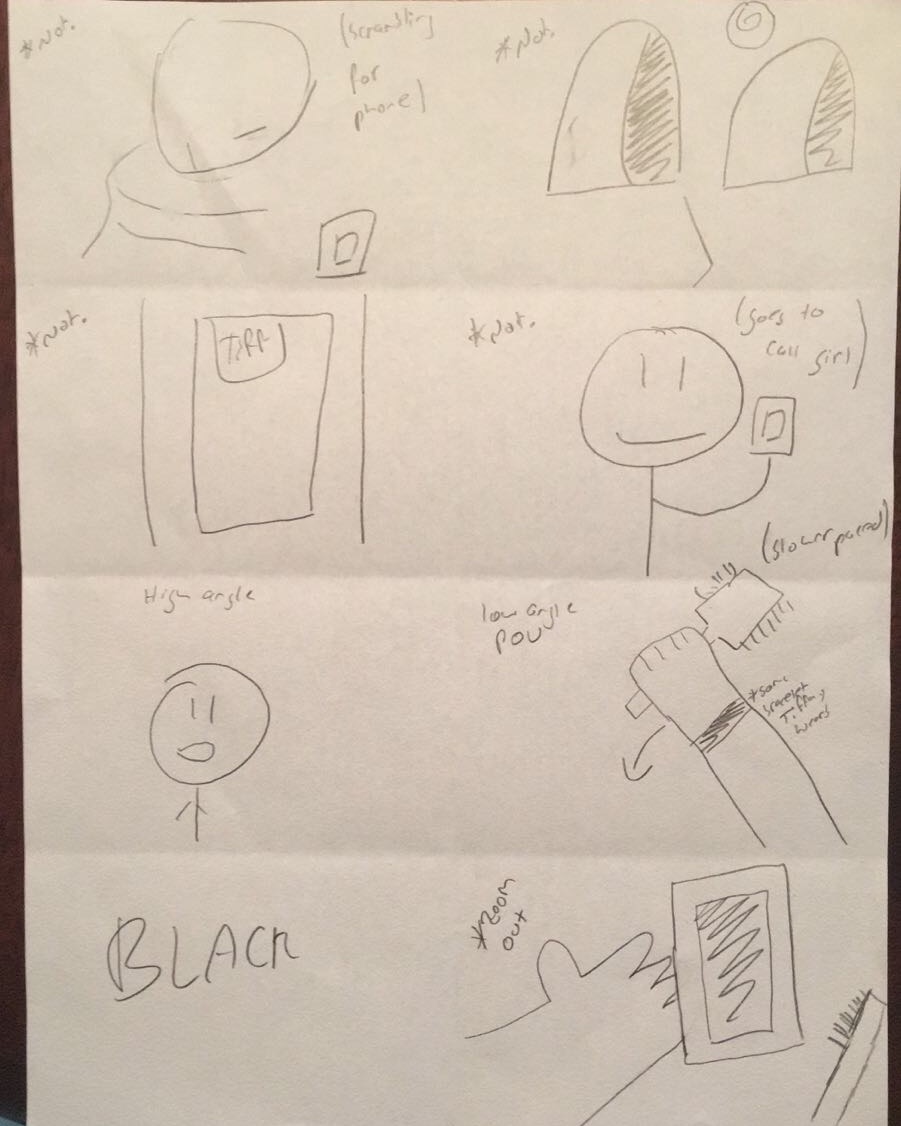
Finished Storyboard!


Although our storyboard may be crudely drawn, it is a much-needed basis for our filming going forward. After much debate on the direction of our film opening, I am glad my group has come to agreement on the proper shots, angles, and composition to convey our message. In the past, I have received criticism that my films needed to include a greater variety of shots and angles, and I hope the shots and angles we are utilizing will help portray the plot in a clear and meaningful way. 

An issue I feel like we might run into is not being able to properly shift the mood of the film opening after the title card plays and the setting changes. We wanted to include parallelism in our shots to give an audience the sense that both girls are similar in personality and desires (of validation, acceptance, and popularity); especially in shots which could be indicative of a focus on appearances (like applying makeup) we chose to similarly shoot both Tiffany (the protagonist/ murderer) and Brittney (her victim). Another concern I have is if we will be able to properly convey this "hot and cold" stalking scene, where Tiffany attempts to locate Brittney by listening for the sound of phone notifications. Recording sounds from varying distances and adding sound effects (through foley and credited free music archives) should be a considerable part of our work in the editing process.

Darkness is going to play an integral part in our film opening, and we may face difficulties lighting our shots because of this. Experimenting with lighting and shots should be integral in our success.  My main concern is that the mood of our film will be inconsistent with our vision. Hopefully we will be able to find a good balance between comedic social criticism and suspense.


Tuesday, March 20, 2018

Distributing on a Budget

Although production on our film opening seems to be our sole concern, productions cannot often find widespread success without research into effective distribution of the film. Due to the fact that our film opening is clearly produced on a low budget, we would pursue appropriate distribution methods. Especially with a target audience of teenagers and young adults (many of whom consume much digital media), it may be wise to seek digital distribution for our film.  

In the article "Finding Distributors for Your Low-Budget Horror Film" from Videomaker Magazine, it is explained that in order to have your film distributed by large Video on Demand services (like iTunes), one must work with Aggregators; Aggregators offer a method of distribution to large digital distributors but require a fee or percentage of profits in advance. Securing a digital distributor would possibly prove difficult (with distributors such as Netflix and Hulu now shifting toward high budget productions with much oversight from the distributors), but if these digital distributors were willing to entertain independent film makers, this could be a good option. 

Justin Schwarz and Laura Kleger, creators of the independent film "The Discoverers", recommended a traditional, smaller scale route to film distribution in an article about the strategies they used for distribution; through crowd-sourced funding on websites like Kickstarter, they were able to raise over $100,000 for the purpose of distribution. According to the creators of "The Discoverers", due to a focus on regions where the film had exposure at festivals and had many people within their target demographic, their film "played in more than 25 cities, was in movie theaters for nearly six months and garnered great press." 

If we were unable to find a willing distributor initially, digital self-distribution, distribution at regional film festivals, and grassroots marketing (utilizing social media and reaching out to individual film reviewers) could publicize the film to the point where larger distributors were willing to pick up the project. Even though many dream of immediately finding box office success and creating buzz across Hollywood, a more realistic goal for amateur filmmakers is finding a local or online audience to consume their films.

Whether we chose to self-distribute and take the burden of marketing on ourselves or seek a willing large/small-scale distributor to work with an possible lose profits but gain an audience would largely depend on our distribution budget and initial audience reception. Digital distribution through an Aggregator seems the most feasible and fitting for our film; it seems to appeal to the digital consumption habits of teenagers, require less-intense spending than traditional distribution, and give us more options on distributors to work with.

Schwarz, J., & Kleger, L. (2016, May 28). Attention, Filmmakers: Here's How to Self-Distribute Your Film. Retrieved March 20, 2018, from http://www.indiewire.com/2014/12/attention-filmmakers-heres-how-to-self-distribute-your-film-66885/


Siegel, J. (n.d.). Finding Distributors for Your Low-Budget Horror Film. Retrieved March 20, 2018, from https://www.videomaker.com/article/c12/17035-finding-distributors-for-your-low-budget-horror-film


Monday, March 19, 2018

Scheduling is Hard

Our schedule has unfortunately met multiple delays due to issues finding actors who are available for filming on the same dates as us and securing a filming location. Creating a filming with so many constraints is proving difficult. One of our actors dropped out because of her schedule becoming busy and another was only available on days which conflicted with our schedule; we have had to replace both actresses, but it has been very detrimental to our ability to shoot the film opening. Although we are just utilizing amateur actors, I have found that the success and length of time production of a film takes often hinges on scheduling. Especially with highly character-based stories, it is not very easy to work around actors' lack of availability.

Filming Schedule

3/29- Begin filming

3/30- Continue filming

3/31- Continue filming/ Begin editing (as needed)


We'll have to speed up the editing process due to our delayed filming, but let's hope for the best.


Friday, March 16, 2018

Group Meeting Insights

Today, I was given the opportunity to get the opinions and critiques of my peers concerning the work I have done on my film opening so far. Although it was difficult to explain my ideas coherently as I spoke to my group, I was luckily able to receive many valid and enlightening criticisms of the work Chancellor, Jacob, and I have done.

The group that I met with came to a consensus on various changes which (I tend to agree) would improve my film opening. 

Two of my group members were also working on film openings in the horror genre, and this was very valuable to gaining constructive criticism. All of my group members tended to agree that including more elements of horror immediately in the film would allow it to more closely reflect the intended genre. Especially in the introduction of the protagonist, they believed not enough suspense would have been created without the inclusion of more tension during the opening sequence. They agreed that certain aspects we had thought of, such as Tiffany searching for Britney utilizing the sound of social media notifications, was interesting and would properly build suspense. 

The issue with the feedback Jacob and I received was that the students in his critique group seemed to believe the polar opposite of what my group members thought. While mine believed we needed more horror elements and less introduction of the protagonist, his group believed we should not even reveal any killings by the protagonist in our film opening at all; instead, they believed our introduction of the protagonist should be expanded upon. Chancellor's group seemed to like our ideas as they are, leaving us at a crossroad. 

The idea that all groups agreed upon in their advice is that our plan to begin filming on March 24 was too soon. Our group members told us that filming a mock film opening using ourselves rather than the real actors would be beneficial to our planning and refining of cinematographic techniques.

Which advice we decide to take will truly shape our production. 


Thursday, March 15, 2018

Tiffany and Britney

Before we start to look into casting, it is important to define and outline our characters. Chancellor, Jacob, and I have discussed the physical and personality traits we envision for our protagonist, Tiffany, and her victim, Britney. We especially wanted to stay away from the trope of a creepy loner that is obsessed with a popular peer. In order to do so, we want to make it clear to the audience that both characters occupy an equal social status. Additionally, both characters have a similar habits of social media, but Tiffany's obsession clearly plays out in a more exaggerated and unrealistic way in our film opening.

By emphasizing aspects such as vanity and desire for popularity, we believe that social commentary will be more impactful and clear to the audience. Even by their names alone, it can be inferred that both girls hold stereotypical teenage, feminine roles; although this plays into the audience's preconceptions on teenage girls, this portrayal serves as a vehicle for the commentary. Both characters are supposed to be around 17 years old, which places them at an age clearly within teenage years, but also old enough to appeal to a more mature audience.

The typical image of a popular girl we had was a blonde, bossy girls, which I must say has been highly influenced by stereotypical portrayals of girls in the media. Often, teenage girls are placed given labels based on their physical appearance, with aspects such as hair color serving as arbitrary indicators of  personality. As we plan to satirize these ideas in our film opening, we want to emphasize the ridiculousness of these negative stereotypes. According to a study conducted under the
International Central Institute for Youth and Educational Television, men are disproportionately represented as protagonists in television due to the belief that men are more relatable to both men and women than women are. Especially among viewers of "slasher" films, this belief in female disinterest in the genre is prevalent. In order to increase the potential female audience of our film and the horror genre overall, I believe it is important to subvert these gender norms.

Media and Girls. (n.d.). Retrieved March 15, 2018, from http://mediasmarts.ca/gender-representation/women-and-girls/media-and-girls

Nowell, R. (2011). Blood money: a history of the first teen slasher film cycle. New York: Continuum.


Creative Critical Reflection

For a higher quality version of my CCR video please click here . Thank you so much for taking the time to watch my film opening and re...